
Cartier watches have surged in popularity in recent years, particularly its most iconic and historical models. Yet obtaining the most sought-after pieces from the Privé line has become increasingly difficult, with allegations that Cartier is not prioritising its most devoted collectors when allocating limited-production models—many of which find their way onto the secondary market at highly inflated prices. Meanwhile, Cartier has released a number of lower-cost but equally desirable models that proved very difficult for prospective buyers to obtain initially, yet for which production has continued for years despite the brand suggesting they would be limited. So, does Cartier really have its collectors’ interests at heart?
The prime example of the first issue is the Tank à Guichets launched in 2025. This was a reissue of a very rare jumping-hour model first released by Cartier in 1928, produced only sparingly since, and not at all since 2006. Four new interpretations of the historic model were released in 2025. Faithful to the original concept, each retained the signature aperture display, with jumping hours and dragging minutes shown through a solid metal façade. The collection comprised versions in yellow gold, rose gold, and platinum, alongside a platinum limited edition distinguished by a rotated dial layout.
While only the “oblique” version is strictly a limited edition (200 pieces), the others have not been easy to obtain, with even some of the highest-profile collectors complaining about lack of allocation. And yet, a quick search on Chrono24 reveals dozens of these watches listed for sale by dealers, generally for around 2.5 times the original list price. The allegation, therefore, is that Cartier is not prioritising selling these watches to dyed-in-the-wool Cartier fans who would never sell, but has let them go to less devoted purchasers who have no qualms about flipping their allocations for a quick profit.

At the other end of the market, in 2021 Cartier released a trio of monotone Tank Must watches in steel with plain lacquer dials in green, blue, and red. These models harked back to the Must de Cartier line first introduced in the 1970s. Upon release, it was widely publicised that these watches—which were not a limited edition—were “one-shot,” meaning they would be produced for a limited time before being withdrawn from the market and not produced again. These models were very popular and initially hard to get. The limited production clearly increased their desirability and, as with the Tank à Guichets models discussed above, a flurry of these watches were released with steep mark-ups on Chrono24 and elsewhere. However, now, five years later, these models remain listed on the Cartier website and are apparently still being produced. I don’t think anyone would imagine that a “one-shot” production would last for a whole five years!
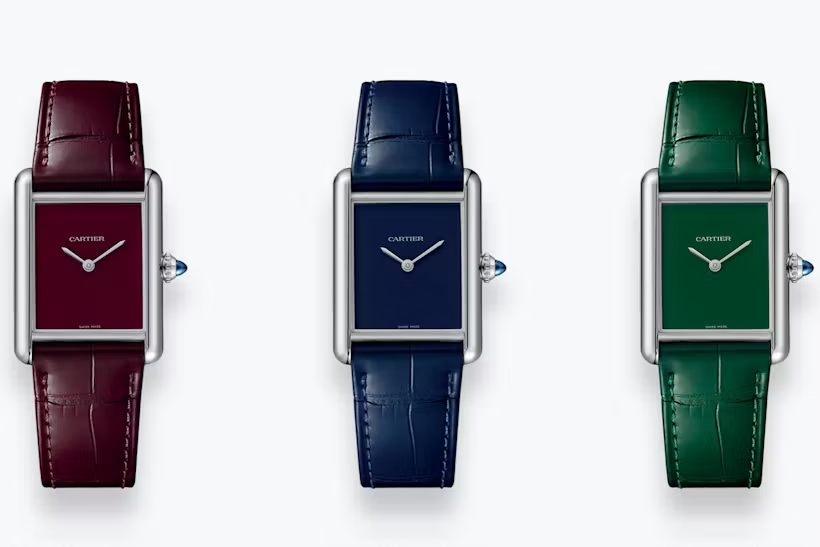
Does any of this really matter, and what does it tell us about how Cartier treats its loyal customers? With regard to the Tank à Guichets, one might reasonably say that Cartier, like any retailer, can sell its products to whomever wants them. If the market dictates that prices should be higher than Cartier’s list price, then the buyer has every right to sell their watch on to someone else at a higher price. However, the process by which Cartier selects who gets to buy one of these pieces lacks transparency and appears quite random. Either a first-come-first-served system open to everyone, or a system that transparently rewards loyalty, would surely be preferable.
Cartier’s approach to the “one-shot” Tank Musts is even less defensible in my opinion. Again, transparency is key. Cartier should have specified clearly what “one-shot” actually meant. How long would these models actually be produced for? One of the reasons people bought these models was precisely because they thought they were buying something a bit special that wouldn’t be available forever. By continuing production for half a decade, Cartier has made these models less special than they might otherwise have been, and that is not fair to the collectors who bought them in good faith back in 2021.